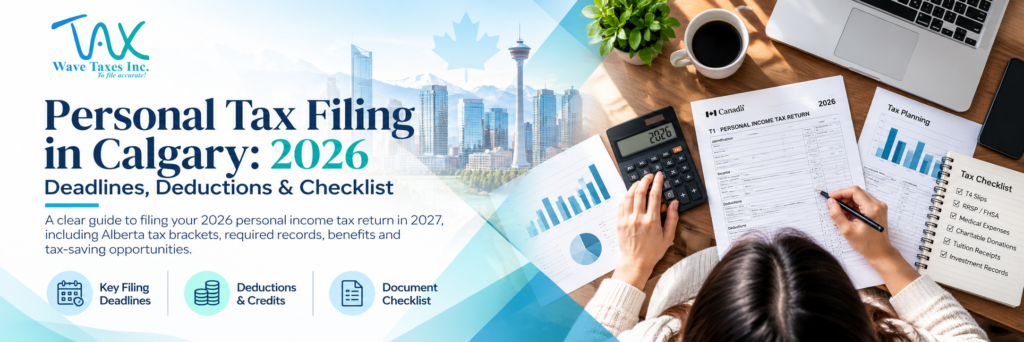
A clear guide to filing your 2026 personal income tax return in 2027, including Alberta tax brackets, required records, benefits and tax-saving opportunities.
| April 30, 2027 — Most T1 filing and balance-payment deadline |
June 15, 2027 — Generally, qualifying self-employed T1 filing deadline |
One T1 return — Federal and Alberta personal tax calculated together |
2026 personal tax filing deadlines
| Key date |
What it means |
| March 1, 2027 |
Expected deadline for contributions deductible for the 2026 RRSP tax year (first 60 days of 2027). |
| April 30, 2027 |
T1 filing deadline for most individuals; personal tax balances payable. |
| June 15, 2027 |
General filing deadline for qualifying self-employed individuals and their spouses/common-law partners; tax balances remain due April 30. |
| March 15, June 15, September 15, December 15, 2027 |
Regular individual instalment dates, if required; check adjustments for weekends and holidays. |
CRA exceptions can apply, including for deceased taxpayers and specific self-employment circumstances. Verify your situation before relying on an extended deadline.
2026 personal income tax rates: Alberta and federal brackets
For Alberta residents, federal and Alberta income taxes apply to the same taxable income through progressive tax brackets. Each marginal rate applies only to the portion of income within that bracket, before credits and other adjustments.
| 2026 Alberta taxable income band |
Provincial marginal rate |
| Up to $61,200 |
8% |
| $154,259 |
10% |
| $185,111 |
12% |
| $246,813 |
13% |
| $370,220 |
14% |
| Above $370,220 |
15% |
2026 federal personal income tax brackets
| 2026 federal taxable income |
Federal marginal rate |
| Up to $58,523 |
14% |
| $58,523.01 – $117,045 |
20.5% |
| $117,045.01 – $181,440 |
26% |
| $181,440.01 – $258,482 |
29% |
| Over $258,482 |
33% |
Example: An Alberta taxpayer with $70,000 of taxable income does not pay one flat rate on all income. The first $58,523 is in the 14% federal bracket and the remaining taxable income enters the 20.5% federal bracket; Alberta brackets are calculated separately. Deductions and non-refundable credits can reduce final income tax.
Personal tax document checklist
| Category |
What to gather |
| Income |
T4, T4A, T4E, pension slips, T5, T3, T5008, foreign-income summaries, crypto dispositions and other taxable receipts. |
| Family and credits |
Childcare receipts, medical expenses, charitable donations, tuition T2202, disability tax credit approval, student loan interest. |
| Tax planning |
RRSP/FHSA receipts, prior Notice of Assessment, carryforwards, instalment records and CRA correspondence. |
| Rental or side business |
Rental income and supporting expenses; business revenue, invoices, receipts, mileage and home-office records. |
| Other |
Moving-expense documents, eligible employment-expense records and investment cost-basis information where relevant. |
Deductions and credits worth checking
- RRSP and FHSA: Contribution eligibility and deduction limits differ; review your available room and supporting slips.
- Childcare: Verify eligible expenses, limits and which spouse generally claims them.
- Medical costs: Keep receipts and compare eligible claim periods and family-grouping options.
- Tuition and student loans: Review available credits, transfers, carryforwards and eligible government student-loan interest.
- Donations: Combining eligible donations on one spouse’s return may improve the credit.
- Employment and home-office expenses: Confirm eligibility and required employer certification; expenses are not automatically deductible just because you work remotely.
- Housing and disability-related credits: Review eligibility for the home buyers’ amount and the disability tax credit.
Special cases: self-employment, rentals and investments
| Your circumstances |
How to report it and what to review |
Common risk / missed opportunity |
| Sole proprietor, freelancer or gig worker |
Report gross business income, eligible expenses and business-use allocations on T2125 with the T1. Reconcile invoices, bank deposits and payment-platform statements. |
Unreported cash/platform income; personal expenses deducted as business; missing GST/HST registration or filing. |
| Rental home or basement suite |
Report rental revenue and eligible expenses on T776; allocate shared household expenses reasonably. Review ownership percentages and capital-versus-current costs. |
Omitting short-term or basement rent; deducting mortgage principal; improper CCA on a principal residence. |
| Investments, crypto or share sales |
Reconcile T3/T5/T5008 slips with brokerage transactions, adjusted cost base, dividends and disposition records. Assess capital gains/losses and foreign-property reporting. |
Treating T5008 proceeds as capital gains; ignoring adjusted cost base or crypto dispositions; missing T1135 where applicable. |
| Newcomer or part-year Canadian resident |
Report the residency entry date and applicable worldwide income for the Canadian-resident portion of the year; review prorated credits and benefit registrations. |
Missing foreign income disclosures or assuming zero Canadian income means no benefits-related filing or applications. |
For eligible foreign property, a T1135 reporting obligation may arise when the total
cost amount exceeds CAD $100,000 at any point in the year. Some exceptions apply.
What changed in 2026?
Alberta’s 8% first bracket and the federal 14% first bracket apply to the relevant portions of 2026 taxable income. The
Canada Groceries and Essentials Benefit (CGEB) replaced the GST/HST credit in July 2026; it remains tied to tax-return-based eligibility and is paid separately from any personal income tax refund.
What happens when you file with Wave Taxes?
01 Collect records → 02 Reconcile information → 03 Review deductions → 04 Approve and file → 05 Review assessment
We organize available records, identify missing information, review potential deductions and credits, explain the projected result, and submit the return after your authorization. Once CRA issues its Notice of Assessment, any differences or subsequent review requests should be checked promptly.
Common filing errors and late-return consequences
No CRA My Account access: Without an account or authorization, it may be harder to confirm assessed returns, notices, available RRSP limits, tuition carryforwards, disability approvals and past-year balances. Some credits still require additional eligibility checks and documents.
Filing before all slips arrive: Missed T4, T4A, T5, T3 or investment slips can cause omitted income, reassessments, interest and delayed refunds. Compare slips against employer/bank records and CRA information.
Not reviewing the whole family’s circumstances: Canada does not have a single family income tax return. Each individual generally files separately, but spouses’ information and support for eligible parents or grandparents can affect available amounts or transfers, subject to strict eligibility rules.
Missing disability-related opportunities: A qualifying family member may be eligible for the disability tax credit (DTC), unused disability-amount transfers, the Canada caregiver amount, medical expenses or RDSP-related benefits. CRA approval and eligibility conditions matter; a diagnosis alone does not guarantee the DTC.
Overlooking prior-year claims: Unused tuition amounts, capital losses, donations, RRSP deductions or reassessments from earlier years may warrant review; not all credits transfer or carry forward.
Not reporting worldwide income or changes in residency, marital status or dependants when required.
Claiming ineligible employment or home-office expenses without necessary employer certification and adequate supporting records.
Missing rental income, self-employment receipts, online marketplace revenue, crypto transactions or foreign-property reporting.
Late filing when tax is owing: Penalties and compound daily interest may apply; late filing can also delay income-tested benefits.
For a first late filing with a balance owing, CRA’s standard penalty is generally 5% of the balance plus 1% for each full month late, up to 12 months. Higher repeat-offender penalties can apply under specific conditions.
Personal tax FAQs
If I am self-employed, can I wait until June to pay?
No. The general extended filing deadline does not extend the April 30 balance-payment deadline.
Can Wave Taxes help with a CRA review?
Yes. Our team can help organize supporting documents and respond to review or reassessment correspondence as a separately scoped service.
I have zero income and I landed in November 2026. Do I need to file taxes?
If you became a Canadian tax resident in November 2026 and had no income, you may not be required to file solely because you arrived. However, filing a 2026 return may establish information used for benefits and credits, and newcomers may need separate benefit applications. Your residency status, spouse’s income and other circumstances should be reviewed.
Can I file one family income tax return for my spouse, parents and grandparents?
No. In Canada, individuals file their own T1 returns. Family relationships still matter for certain credits, including eligible-dependant, caregiver, disability transfers and some medical expenses, when the legal criteria are met.
My parent or grandparent lives with me. Can I claim them as a dependant?
Possibly, but living together alone does not qualify you. The eligible-dependant amount generally has marital-status and support tests; the Canada caregiver amount has different rules and normally requires an impairment. Review the relative’s income and your circumstances.
A family member has a disability. Can I claim the DTC?
The person must meet CRA disability tax credit criteria and obtain approval (typically using Form T2201). Some unused disability amounts may transfer to an eligible supporting family member. Other programs and prior-year adjustments may also be worth examining.
I forgot to report a T4 or T5. Should I file another return?
Usually you request a change or adjustment to the filed return rather than filing a second original return. Reconcile the missing slip, review the Notice of Assessment and submit the correction through the applicable CRA channel.
I cannot sign in to CRA My Account. Can I still file?
Yes, depending on available slips, identity information and the filing method. Creating or recovering CRA access is useful for reviewing prior-year records and notices, but your return should not be delayed unnecessarily if complete reliable records are available.
Can missed tuition or other credits from prior years be recovered?
Sometimes. Certain amounts carry forward automatically or can be corrected using a prior-year adjustment, depending on the credit, year and CRA rules. Review prior assessments and carryforward schedules before making a claim.
Is my Alberta income tax a separate return?
No. For most Alberta residents, federal and Alberta personal income tax are calculated together on the T1.
Prepare your 2026 personal taxes with confidence
Wave Taxes supports individuals, families, landlords and self-employed professionals in Calgary and across Alberta.
Contact Wave Taxes to get started →