
Personal Tax Filing in Calgary: 2026 Deadlines, Deductions & Checklist
Understand T1 versus T2 returns, corporation deadlines, GST/HST, payroll and the records you need for an organized Alberta business year-end.
T1 + T2125 — Typical reporting for sole proprietors | T2 return — Separate corporation income tax return | Fiscal year-end — Determines corporate tax due dates |

First, identify your business structure
Business tax filing is not identical for every business in Alberta. The most important distinction is whether the business is legally incorporated or operated personally.
Business type | Income tax filing | Filing basis |
Sole proprietor / independent contractor | Personal T1 with business Form T2125 | Generally calendar-year personal return; qualified self-employed filing deadline may extend to June 15. |
Partnership | Partners generally report allocated income; a T5013 partnership information return may also be required | Partnership filing requirements and partner types determine additional obligations. |
Alberta or federal corporation | Separate T2 corporation income tax return | Generally due within six months after corporate fiscal year-end, regardless of whether income tax is owed. |
Important: A corporation and its shareholder are separate taxpayers. Filing the shareholder’s personal income tax return does not replace the corporation’s T2 filing requirement.
Business tax deadlines: which date applies?
Obligation | General rule | Example: December 31, 2026 year-end |
T2 corporation income tax return | Six months after fiscal year-end | June 30, 2027 |
Corporate income tax balance | Generally two months after fiscal year-end; qualifying CCPCs may have three months | Generally February 28, 2027; potentially March 31, 2027 if eligible. Weekend/holiday rules may move actual deadline. |
Annual GST/HST for a typical corporation | Three months after GST/HST fiscal year-end | March 31, 2027 |
Self-employed individual T1 | Generally June 15 following tax year if eligible; income-tax payment April 30 | File June 15, 2027; pay April 30, 2027 |
Annual GST/HST sole proprietor meeting the special criteria | File June 15; remit April 30 | File June 15, 2027; pay April 30, 2027 |
Payroll remittances / T4 slips | Due dates depend on remitter type; T4 reporting generally follows calendar-year schedule | Check CRA payroll remitter account and T4 deadline. |
Corporate instalments may also be required monthly or, for eligible corporations, quarterly. GST/HST reporting frequencies vary; a GST/HST filing deadline should not be inferred from the corporation’s T2 deadline.
Business filing workflow

Business year-end preparation generally adds balance-sheet reconciliations, depreciation schedules, shareholder account analysis and tax adjustments before the return can be filed.
Records needed for a business year-end
Business area | Typical records |
Sales and receivables | Invoices, POS reports, payment processors, accounts receivable and customer credit notes. |
Purchases and overhead | Vendor bills, credit-card statements, rent, utilities, subscriptions and business expenses. |
Bank and financing | Bank statements, loan agreements, interest and principal balances, financing changes. |
Employees and contractors | Payroll summaries, T4/T4A details where applicable, source deductions, benefits, contractor payments. |
Assets and tax | Vehicle/equipment purchases, disposals, capital cost allowance pools, GST/HST and tax instalments. |
Corporate-specific | Prior T2, incorporation information, financial statements, shareholder loans, dividends, related-party transactions. |
How business expenses affect taxable income
Deductible business expenses generally must be incurred to earn business income and meet CRA requirements. Some items are limited, treated as capital expenditures, or disallowed. GST/HST input tax credits are considered separately where applicable.
Example expense | Typical treatment / caution |
Rent, business utilities and insurance | Normally deductible to the extent incurred for business; retain invoices and allocation records. |
Meals and entertainment | Commonly subject to a 50% limitation, with exceptions. |
Vehicle costs | Track business-use kilometres and actual eligible expenses; purchases may require capital cost allowance. |
Equipment and software | Treatment depends on whether current expense or capital property and relevant tax measures. |
Owner withdrawals / dividends | Not automatically deductible as business expenses; salary, dividends and shareholder loans have different treatments. |
Loan payments | Interest may be deductible if conditions are met; principal repayment generally is not an expense. |
Corporate tax: illustrative rates, not a flat rate on revenue
For a qualifying Alberta Canadian-controlled private corporation (CCPC), the combined small-business corporate income tax rate is often 11% (9% federal + 2% Alberta) on eligible active business income within the applicable small-business limit. Ordinary general corporate income may face a different combined rate, often 23% (15% federal + 8% Alberta). The business limit, association, passive investment income, provincial allocation and other rules may change the result.
CORPORATE TAX RATE COMPARISON | ALBERTA + FEDERAL
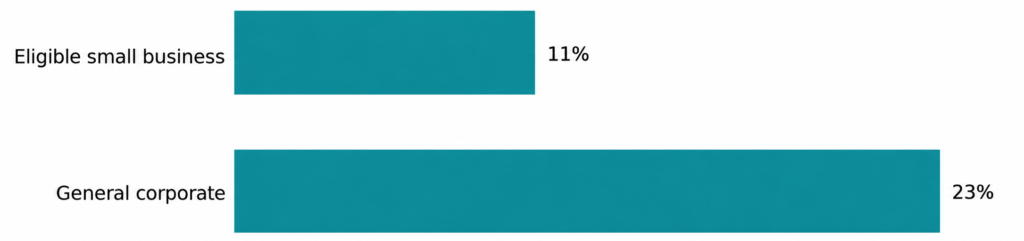
Rates are illustrative statutory rates for eligible income categories, not an effective-rate forecast and not rates applicable to all corporations or all income. Confirm classification and current legislation before publication.
GST/HST, payroll and Alberta-specific obligations
- GST/HST: Registration requirements, collected tax, input tax credits, return frequency and payment dates should be reviewed separately from income tax.
- Payroll: Review CRA remittance frequency, source deductions, T4 reporting, taxable benefits and year-end reconciliations.
- Alberta corporate tax: Corporations with Alberta reporting obligations may need Alberta AT1 filing in addition to the federal T2, subject to exemptions and applicable rules.
- Industry requirements: PST in other jurisdictions, WCB, licenses and sector-specific reporting may apply to a business even if it operates from Calgary.
Business tax FAQs
Can an incorporated business file its taxes with the owner’s T1?
No. The incorporated business generally files a separate T2, while the owner reports personal salary, dividends and other individual income on their T1.
Does every corporation have until June 30 to file?
No. June 30, 2027 is the standard six-month deadline only for a corporation whose tax year ends December 31, 2026, subject to applicable deadline rules.
Do GST/HST and corporate income tax have the same due date?
Not necessarily. Their reporting periods, payment rules and deadlines can differ.
Should I pay myself a salary or dividends from my corporation?
Salary is generally deductible to the corporation when reasonable and properly paid or accrued, creates RRSP earned income, and normally attracts CPP contributions and payroll remittances. Dividends are distributions of after-tax corporate profits, are not deductible to the corporation, generally do not create RRSP room or CPP pensionable earnings, and are reported on a T5. The better approach depends on your personal tax bracket, corporate income, cash needs, retirement plans and overall corporate/personal tax integration. A combination may be appropriate.
Can declaring a year-end bonus reduce my corporation’s tax for that year?
Potentially. A properly authorized, reasonable bonus accrued as a genuine liability by the corporate year-end may reduce that year’s taxable business income, provided the deduction requirements are met and it is actually paid within 180 days after year-end. If unpaid after 180 days, the deduction is generally deferred until the year of payment. Payroll withholdings and T4 reporting generally arise when the bonus is paid or received. For example, a qualifying $30,000 bonus accrued at December 31, 2026 and paid within 180 days may reduce 2026 corporate taxable income by $30,000; it does not mean $30,000 of tax savings. The recipient is taxed personally on the bonus, so evaluate the combined result before declaring it.
What income-splitting options are available for a family-owned business?
Possible options include paying a spouse or adult family member a reasonable salary for actual work performed, allocating income between genuine business partners according to their interests and contributions, and paying eligible dividends to family shareholders where the tax on split income (TOSI) rules or an exception permit it. Share ownership alone does not make dividends tax-efficient. Document duties, hours, compensation, ownership and the source of funds. Special planning, including prescribed-rate family loans where appropriate, requires professional advice; transferring income informally or paying unreasonable wages can create reassessments.
Make business year-end filing more manageable
Wave Taxes supports Alberta entrepreneurs with bookkeeping, GST/HST, payroll coordination and business tax preparation. Complex corporate tax work may require specialized CPA review.